April 7, 2026: The first CBAM certificate price will be published
On March 6, 2026, the European Commission's Directorate-General for Taxation and Customs Union (DG TAXUD) announced a key milestone in the implementation of CBAM: the first quarterly price of CBAM certificates will be published on April 7, 2026. This information has direct operational implications for all importers of goods covered by the mechanism. What does this mean?
China and CBAM: From Trade War to Cooperation? What New Research Tells China's Steel and Aluminum Importers
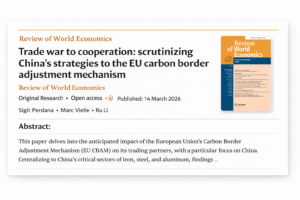
In March 2026, the prestigious journal Review of World Economics published a comprehensive analysis of China's strategic responses to the EU's CBAM mechanism. The authors, economists from the École Polytechnique Fédérale de Lausanne (EPFL) and Chengdu University of Technology, examined several scenarios of how the Chinese economy might react. The results are important not only for climate policy but also for

New TARIC codes for CBAM – what changes from 1 January 2026 and why importers need to prepare today
From January 1, 2026, the Carbon Border Adjustment Mechanism (CBAM) will enter its target phase. The transition period based solely on reporting ends, and the phase of actual financial and customs consequences begins. One of the least media-reported, yet most critical, elements of this change are the new codes on the customs declaration associated with

Tax incentives for decarbonization – the European Commission shows the carrot next to CBAM
On July 2, 2025, the European Commission published a recommendation on tax incentives supporting the Clean Industrial Deal. This sends an important signal to industry: the EU not only imposes costs on emissions (CBAM, EU ETS) but also offers concrete benefits to companies investing in clean technologies. We examine what this means for Polish businesses. Clean Industrial

The European Commission simplifies the procedures for obtaining the status of an authorised CBAM notifier
On December 10, 2025, the European Commission published a new implementing regulation amending the rules for applying for CBAM Authorized Declarant status. The most important change? You can import CBAM goods even while waiting for a decision on your application. Temporary import for applicants. This is a key change for all companies applying for CBAM Authorized Declarant status.

CBAM Guarantee – How to Calculate Its Amount? A Practical Guide for Importers
Are you applying for CBAM Authorized Reporting Entity status, but your company has been operating for less than two years? You must submit a financial guarantee. KOBiZE has just published instructions on how to calculate it. We'll break down the issue. What is the CBAM guarantee and who does it apply to? The CBAM guarantee is one of the requirements that an applicant must meet.

The President signed the CBAM Act – what changes for importers from 2026?
On December 18, 2025, the President of the Republic of Poland signed the act implementing the CBAM mechanism into Polish law. This is a breakthrough moment for all companies importing steel, aluminum, cement, fertilizers, hydrogen, or electricity from outside the EU. We explain who is responsible for what, what the new obligations are, and what to watch out for. What is CBAM and

CBAM 2.0 Registry: New System Architecture Changes the Game
On December 10, 2025, the European Commission published Implementing Regulation C(2025) 8580, which introduces significant changes to the operation of the CBAM Register. This isn't a cosmetic update—it's a fundamental overhaul of the system's architecture, changing the way CBAM obligations are managed. For importers, these changes mean both new opportunities and new challenges. Let's take a closer look.

CBAM 2026: Your imports are now being monitored. What do you need to know?
From January 1, 2026, all imports of goods covered by the CBAM mechanism will be automatically reported to the European Commission. This isn't a vision of the future—it's a reality, introduced by the European Commission's new implementing regulation on information provided by customs authorities. For importers, this means one thing: the era of "paper" reporting is coming to an end, and the era of "paperless" reporting is beginning.

Correction of free allowances in CBAM – anatomy of the new implementing regulation
The European Commission has published a draft regulation specifying the rules for calculating the free allowance adjustment (FAA) under the CBAM mechanism. The document, which will enter into force on January 1, 2026, provides a missing piece of the regulatory puzzle and answers a fundamental question: how can we ensure that imports are not treated more favorably than EU production? The Origin of the Problem: Price Adjustment Mechanism

CBAM in the target period 2026-2030: what the EC has just finalized, how the mechanism will actually work and where the financial risk for importers lies
CBAM is entering a phase where it is no longer solely a compliance project, but rather a financial mechanism influencing margins, purchasing decisions, and supply chain architecture. In December 2025, the European Commission published a set of implementing acts and technical documents that finalize the key "open" elements of the model: the methodology for calculating embedded emissions, and verification rules.

Deforestation under control, but wisely, or EUDR 2.0 in practice
EU anti-deforestation law has received its first amendment. "EUDR 2.0"—officially Regulation (EU) 2025/2650 of December 19, 2025—delays the effective date of the regulations and simplifies some requirements. These changes are a response to business concerns and implementation challenges, but do not mean a retreat from forest protection ambitions. Background

Critical Raw Materials Act: A new framework for EU raw materials security in the era of green transformation
Over the past decade, critical raw materials have become a key focus of European industrial policy. The growing demand for zero-emission technologies, digitalization, and defense systems has exposed the scale of the EU's dependence on imported raw materials essential to the functioning of a modern economy. The EU's response is the Critical Raw Materials Act (CRMA), a comprehensive regulation designed to ensure

CBAM in numbers – how much will the EU and Poland earn from the carbon tax at the border and what does it mean for business?
In November 2025, the CAKE/KOBiZE analytical team published the report "CBAM and Budgetary Revenue. Prospects for the EU and Poland", which directly asks a question that has rarely been discussed openly so far: how much money will CBAM actually bring to the budget of the European Union and individual member states, including Poland, and what significance will they have?

EUDR – a breakthrough in implementation: EU Council and Parliament reach agreement on targeted revision
On 4 December 2025, the Council of the EU and the European Parliament announced a provisional political agreement on a targeted revision of the Deforestation-Free Regulation (EUDR). The new compromise aims to facilitate practical implementation, reduce administrative burdens, and give companies and governments more time to prepare for full compliance.

CBAM Authorised Reporter Status – What do you need to know before January 1, 2026?
From January 1, 2026, only authorized declarants will be able to import goods covered by the CBAM into the European Union. Here's a comprehensive guide to the new requirements and procedures. What is CBAM and why is it important? CBAM (Carbon Border Adjustment Mechanism) is the EU's carbon border adjustment mechanism.

Is the EU Council planning further delays and simplifications to the EUDR? What does COREPER's decision mean for businesses?
On Wednesday, November 19, 2025, the Committee of Permanent Representatives to the Council of the European Union (COREPER) adopted a negotiating mandate for the next revision of the Deforestation-Free Regulation (EUDR). This decision introduces another delay in the implementation of the regulation and significant simplifications in due diligence procedures, which may significantly impact the way in which

CBAM – The Sejm has passed the bill, and the EU is publishing benchmarks and verification rules. What does this mean for importers from 2026?
On November 21, the Sejm passed an act amending the provisions on the greenhouse gas emissions management system, which implements the CBAM mechanism into Polish law. The act: designates the national authorities competent for CBAM – directors of tax administration chambers as the authorities granting and withdrawing the status of authorized notifier, as well as KOBiZE and GIOŚ as analytical and control institutions; creates

COP30 in Belém: Breakthrough in forest financing, disappointment on fossil fuels
The recently concluded COP30 climate conference in Belém, Brazil, yielded mixed results. On the one hand, negotiators reached a historic agreement to triple adaptation financing and, for the first time, included international trade issues in UNFCCC discussions. On the other hand, the world left the Amazon without a formal plan to phase out fossil fuels, which had been a priority.

The European Commission proposes simplifications. Realism instead of haste.
On October 21, 2025, the European Commission announced a key proposal to amend the implementation of the EU Deforestation Regulation (EUDR), an EU law that aims to ensure that goods entering the EU market do not contribute to deforestation or forest degradation. The latest Commission communication (IP/25/2464) is of strategic importance for both large importers and

Another planned delay to the EUDR: what does the European Commission's decision mean for businesses and forest protection?
On September 23, 2025, the European Commission proposed a second extension of the entry into force of the EU Deforestation-Related Products Regulation (EUDR). Under the new proposal, full enforcement of the regulations is scheduled to begin on December 31, 2026, a full 12 months later than planned after the first revision.

ETS2 – the new emissions trading system for transport and buildings. What does it mean for business?
On September 23, 2025, the European Parliament's Committee on the Environment, Climate and Food Safety (ENVI) held a debate on the extension of the EU Emissions Trading System to new economic sectors. This is the so-called ETS2, a separate system covering emissions from road transport and buildings. This is one of the most important climate expansions.

The European Parliament at COP30 in Brazil. What does this mean for global trade and EU climate policy?
In November 2025, COP30, one of the most important climate conferences in recent years, will be held in Belém, Brazil. The European Parliament has just announced that it will send an official delegation to actively participate in the negotiations. This is a signal that the EU wants to strengthen its leadership role in the global climate transformation. What does this mean for business?

CBAM in Poland: the government is working on a law implementing a border price adjustment mechanism taking into account CO₂ emissions
Climate change is one of the greatest challenges of the 2050st century. For over two decades, the European Union has consistently shaped climate policy aimed at reducing greenhouse gas emissions and achieving climate neutrality by XNUMX. The European Emissions Trading System (EU ETS), covering the largest installations, remains a key instrument in this process.

Changes in the CBAM mechanism after the "Omnibus" package - a comprehensive guide for importers
In September 2025, the European Parliament approved a package of changes known as CBAM Omnibus I, aimed at simplifying and strengthening the EU's Carbon Border Adjustment Mechanism (CBAM). These changes significantly reduce the administrative burden for small and occasional importers, without compromising the EU's climate ambitions.

How to Effectively Implement EUDR in Your Organization? A Step-by-Step Guide
The EU Deforestation Regulation (EUDR, No. 2023/1115) changes the way companies importing and placing certain commodities (including timber, cocoa, coffee, palm oil, soy, rubber, beef and derived products) on the EU market must manage their supply chains. The aim is to ensure that products on the European market do not contribute to

How to understand the definition of SME for the purposes of EUDR and CBAM regulations?
The European Union is increasingly introducing distinctions and deferring obligations for SMEs (Small and Medium-sized Enterprises) in its environmental regulations. In practice, however, the definition of an SME is not always consistent, and its application in various legal acts can raise doubts. This issue is particularly evident in two key regulations for